
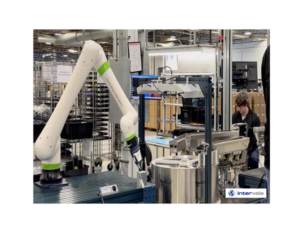
 Modern manufacturing succeeds when technology and human expertise work together
For years, the conversation around manufacturing automation centered on one question: how much of the production process can be automated?
Today, that conversation is changing.
In high-reliability industries like medical devices, aerospace, defense, and industrial electronics, manufacturers face increasing complexity. Component lifecycles are shorter. Supply chains remain unpredictable. Quality expectations continue to rise. At the same time, OEMs need manufacturing partners that can scale efficiently while remaining flexible enough to adapt quickly.
In this environment, the most effective manufacturing operations are not fully automated. They are highly collaborative.
At Intervala, we believe the future of advanced manufacturing is built around the strategic integration of people and automation. Collaborative robots, or cobots, are an important part of that evolution because they enhance human expertise instead of replacing it.
Why Cobots Are Different
Traditional industrial robots were designed for highly repetitive tasks in isolated environments. They excel in fixed processes with little variation. That model still has value in high-volume manufacturing, but it is not always the best fit for complex, high-mix production environments.
Cobots were designed differently. They are intended to work safely alongside people while supporting repetitive or precision-driven tasks such as PCB handling, machine tending, inspection, dispensing, and screwdriving. Because cobots are easier to deploy and reconfigure than traditional robotics systems, they are particularly useful in environments where production demands can shift quickly.
For OEMs operating in regulated or mission-critical industries, that flexibility matters.
A production line assembling medical electronics today may need to support a completely different configuration tomorrow. Manufacturers must be able to respond without sacrificing quality or throughput. Cobots help create that adaptability, but their greatest value comes from how they work together with skilled manufacturing teams.
Precision Still Needs People
Automation can improve consistency, reduce repetitive strain, and support throughput and operational efficiency. What it cannot replace is human judgment.
In advanced electronics manufacturing, experienced operators and engineers remain essential to maintaining quality and solving problems in real time. Skilled teams identify process variations, troubleshoot unexpected issues, manage complex assemblies, and continuously improve workflows in ways that automation alone cannot replicate.
This is especially important in industries where reliability is critical. A defense system, medical device, or aerospace assembly cannot simply meet baseline expectations, it must perform consistently under demanding conditions.
That is why the strongest manufacturing environments are built around collaboration.
Cobots handle repetitive precision tasks with consistency. People provide oversight, adaptability, expertise, and decision-making. Together, they create manufacturing operations that are both scalable and resilient.
Building Smarter Manufacturing Teams
The role of automation should not be to remove people from manufacturing. It should be to help people work more effectively.
At Intervala, we see cobots as tools that strengthen manufacturing teams by improving workflows and reducing unnecessary strain on operators. Repetitive motions that once contributed to fatigue or ergonomic challenges can now be supported by collaborative automation. Employees can focus more of their time on higher-value work that requires skill, attention, and experience.
That shift benefits both manufacturers and customers.
Operations become more efficient and more consistent. Teams become more agile. Manufacturing environments become better equipped to handle evolving customer demands while maintaining the quality standards required in regulated industries.
Most importantly, collaborative automation supports a manufacturing culture where technology and human expertise advance together rather than compete with one another.
What This Means for OEMs
For OEMs evaluating manufacturing partners, automation alone is no longer the differentiator.
The real advantage comes from how effectively a manufacturer integrates technology, engineering expertise, operational flexibility, and workforce capability into a cohesive production environment.
Manufacturers that invest in collaborative automation while continuing to develop skilled teams are better positioned to:
- support high-mix production,
- scale more efficiently,
- maintain quality under pressure,
- adapt to changing product requirements,
- and respond faster to evolving market demands.
At Intervala, we believe the future of manufacturing belongs to organizations that understand this balance.
The goal is not to choose between people and automation. The goal is to build smarter systems where each strengthens the other.
The Future Is Collaborative
Manufacturing continues to evolve, but one thing remains constant: people remain central to quality, innovation, and operational success.
Collaborative automation helps manufacturers create environments that are more precise, more adaptable, and more resilient. The companies that succeed in the future will be the ones that recognize automation is most powerful when combined with human expertise.
See how collaborative manufacturing comes to life on today’s production floor by watching our latest video showcasing the partnership between advanced automation and skilled manufacturing teams.
Learn more: Check out our video of Cobots in Action