
What Aerospace and Defense Supply Chains Should Be Asking
 In aerospace and defense manufacturing, process discipline is not a differentiator — it is the baseline expectation. The question is never whether a contract manufacturer follows a process. The question is how deeply that process is understood, validated, and controlled at every step.
Conformal coating is a process where this distinction matters considerably.
For supply chain leaders managing PCBA sourcing across defense platforms, avionics programs, and defense-adjacent systems, conformal coating quality is one of the more consequential process variables in your supply base. It is also one of the least visible — which is precisely why it deserves closer scrutiny.
The Process Underneath the Product
Conformal coating is not a single action. It is a sequence of interdependent process steps, each of which introduces potential failure modes if not controlled with precision.
A qualified coating process addresses all of the following:
- Surface preparation – Coating adhesion depends entirely on board cleanliness. Flux residues, ionic contamination, and surface oxidation all impair the bond between the coating material and the substrate. Proper cleaning — and verification that cleaning is effective — is the foundation of a reliable coating process. Skipping or shortcutting this step produces adhesion failures that may not be apparent until environmental stress is applied in the field
- Material selection and engineering – Acrylic, silicone, urethane, epoxy, and parylene each offer distinct performance profiles. Acrylic coatings are widely used for their ease of application and rework capability. Silicone coatings extend performance at temperature extremes. Parylene, applied through vapor deposition, provides exceptional moisture and chemical resistance with uniform, pinhole-free coverage across complex geometries. Selecting the right material requires an engineering evaluation of the operating environment, thermal cycling requirements, rework constraints, and component compatibility.
- Masking – Areas that must remain uncoated — connector interfaces, test points, heat-dissipating components — require precise masking before application. Masking errors introduce either contamination risk or coverage gaps. Both are quality escapes that create downstream program exposure.
- Application method and equipment – Selective coating machines apply material to programmed areas with high repeatability. Spray processes can achieve broader coverage but require controlled parameters — flow rate, atomization, standoff distance, and pass speed — to produce consistent results. Manual application, while still used in limited contexts, introduces operator-dependent variability that is difficult to validate at scale.
- Cure validation – Coating cure — whether UV-activated, thermally cured, or moisture-cured — must be verified, not assumed. Undercured coating can remain tacky, absorb contaminants, and ultimately fail to provide the protection it was specified to deliver.
- Inspection – UV fluorescence inspection provides visual verification of coverage. Thickness measurement confirms the coating is within specification. Automated optical inspection identifies voids, dewetting, and anomalies at the component level. All three are standard elements of a mature inspection protocol — not optional enhancements.
Why Process Maturity Is a Supplier Qualification Criterion
Supply chain leaders in aerospace and defense are accustomed to evaluating suppliers against certifications: ISO 9001, AS9100D, ITAR registration. These certifications establish a quality management framework. They do not, on their own, tell you how a specific process is executed and controlled.
Conformal coating process maturity requires a more direct assessment. When qualifying a contract manufacturing partner for PCBA programs in high-reliability environments, the conversations worth having include:
- Who owns the conformal coating process at the engineering level? Is there a senior process engineer with dedicated responsibility for material selection, process development, and continuous improvement — or is coating managed as a general production function?
- How are first-article coating processes validated? What documentation is generated, and how is it retained?
- What is the disposition process for coating defects identified during inspection? How are they tracked, analyzed, and resolved?
- How is rework controlled? Conformal coating rework — removing and reapplying coating — requires precise methods to avoid damaging the underlying assembly. A defined, documented rework process with qualified operators is a meaningful capability indicator.
- What standards govern the coating process? IPC-CC-830 and MIL-I-46058 provide the materials baseline for defense electronics. IPC-A-610 provides workmanship criteria. A manufacturer who is fluent in these standards — and can demonstrate conformance — is operating at a different level than one who applies coating without a standards-referenced framework.
The Supply Chain Consequence of Getting This Wrong
Coating failures in aerospace and defense electronics are not abstract quality events. They translate into:
Field returns and failure analysis costs that consume engineering and supply chain resources across an extended investigation cycle.
Schedule impact when programs require requalification of a process or supplier.
Warranty and liability exposure depending on program type and end-use environment.
Potential mission impact for platforms where electronics reliability is directly connected to operational performance.
The cost of a coating process failure almost always exceeds the cost of investing in the right process controls from the start.
This is the calculation that supply chain leaders in defense manufacturing understand — and it is why coating capability evaluation belongs in the supplier qualification process, not the program risk register.
Engineering-Led Manufacturing for High-Reliability Programs
Intervala supports aerospace and defense PCBA programs where conformal coating is not a commodity step — it is an engineered process outcome. Our team includes dedicated process engineering resources, selective coating equipment, multi-stage inspection, and the documentation infrastructure that regulated programs require.
We engage with customers during design-for-manufacturing review to ensure coating decisions are made with full engineering context, not retrofitted into a production process that was not designed around them.
If you are evaluating contract manufacturing partners for programs where PCBA reliability is non-negotiable, process capability at this level should be part of your assessment criteria.
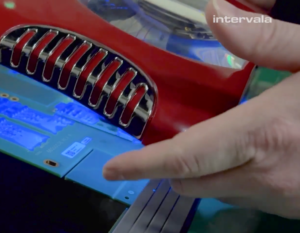
Watch Intervala’s conformal coating process — see the equipment, process controls, and engineering discipline we apply to every program, and assess whether it meets the standard your programs require.